Construction of a hut
Shelter from the wind, rain, Sun and cold and a real dream that decide on the chances of survival in the wild terrain. The better shelter you build, the better you will rest. Good sleep is necessary for the proper functioning of the body, well -being and mental resistance. This, on the other hand, allows you to maintain sobriety of thinking and the will to survive in every situation. The hut in the form of an annex is one of the simplest buildings, It can be done without major problems in almost all field conditions. Shelter should be placed in a safe place and set it up like this, to be facing the wind with a wall that is also a roof. The construction of the hut depends primarily on the materials, what you have. If you have a canvas or plastic cloth, You should use it, For example, covering the roof of the hut. Otherwise you need to cover the plants.
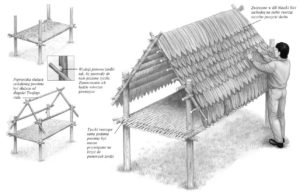
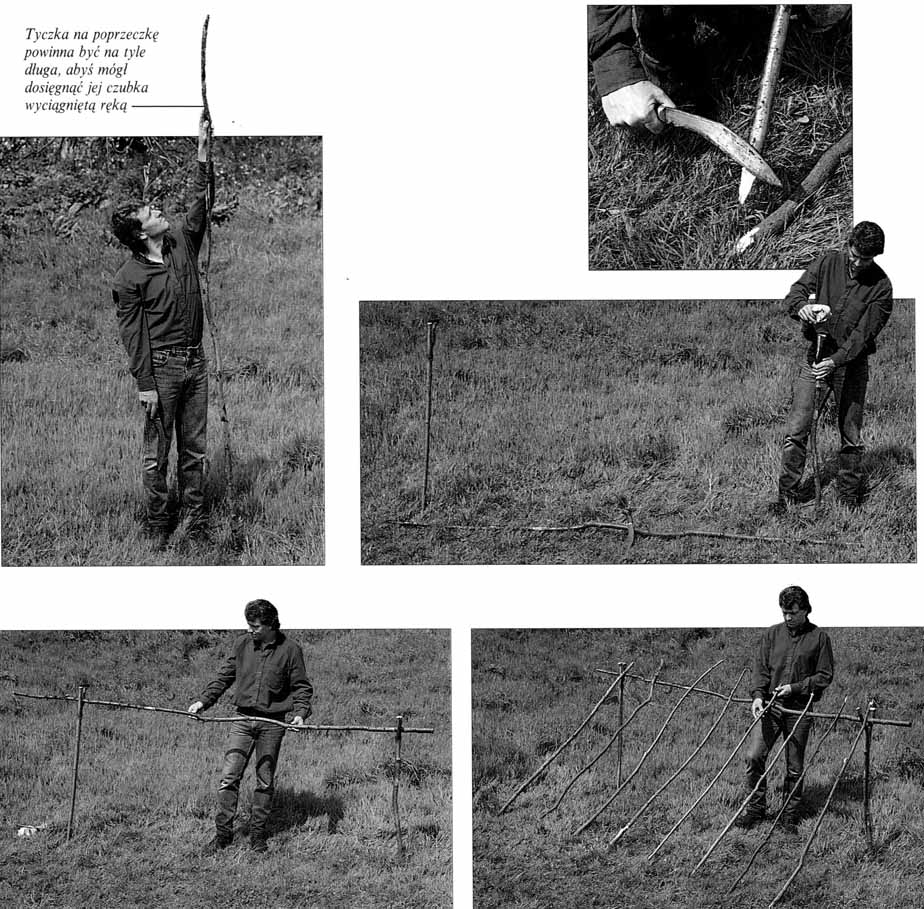 1 The construction of an annex shaped should be started by cutting a long pole, which will act as a ridge, equivalent of the bar connecting the masts in the tent. The crossbar should be the right length. To determine it, grab the branch as high as possible, However, cut around 60 cm above this place. The simpler the branch for the crossbar, the better. Peel her with twigs and knots. Do not use dry branches for the ridge, because they can easily slam under the weight of the leaf roof or in strong winds.
2 Cut two other poles, with forking y -shaped tips; They will be supports. The supports should reach at least a belt. The branches for the supports should be cut with a 30-centimeter supply, for such a length they should be stuck into the ground. Sharp the ends of the supports with a knife, To make them easier to stick.
3 With the help of heavy stone, stick both supports into the ground. They should stand stiffly and not tilt sideways. They should be driven around at a distance of 160 cm, smaller, than the length of the bar.
4 Ułóż poprzeczkę między podpórkami. The bar must be quite light, but at the same time stiff enough, to keep the roof weight and its covering, and, so that it does not break in the event of heavy rain or strong wind.
5 Wytnij kilka prostych i mocnych gałęzi, from which you will make the roof skeleton. They should be this length, so that they could be based on the bar at an angle 45 degrees in relation to the ground. Such a slope of the roof allows water to flow. The distance between poles must be around 20 cm; They should protrude around 3 cm above the bar.
 6 Cut a lot of thin, simple, flexible, and at the same time strong twigs. You can leave the leaves on them. I will cover the branches under and above the skeleton poles, to create a strong grid. Also transfer a few branches over the bar, Then the roof structure will be attached to the bearing frame of the hut (supports and crossbars).
7 Przepleć całe gałęzie z listowiem przez siatkę z tyczek. In this way you will strengthen the roof, and at the same time you will create a layer protecting against wind and rain. The branches with the leaves strengthen the roof structure, But they have this disadvantage, that they wither thinning the roof cover.
8 Intertwine the roof poles with branches so far, until you get the right thickness and density thatched roofs. Try to use various types of branches. Those of the leaves, which dry or wither faster, can be replaced after a few days. New branches are best intertwined over the old, to create a multi -layer roof covering. Branches of small leaves are better, Because large leaves break and dry faster and harder to interlevate them.
9 Gotowy już szałas może wymagać poprawek. For example, it turns out often in strong winds, że dół dachu trzeba przygnieść kamieniami lub ułożyć z kamieni ścianki boczne. Light a bonfire in front of the open side of the hut, But have a care, so that it would not take the roof to cover the flames. It is best to replace dry thatched roofs with a fresh letter.
Use of ready -made materials
Use of ready -made, factory -made materials greatly facilitates the construction of a hut, is less troublesome than preparing everything yourself. Styrofoam plates, plastic bags, The slings of the string can be found often, pounding on the ground. You can also find wooden chests abandoned by people, galvanized sheets, cardboard boxes and a dictation.
Other materials
When building a hut, you can use various ready -made materials abandoned by people.