I remind you of the most commonly used method of swinging the sinking to the shore:
1. We swim to the sinking from the back
2. We grab with one hand for clothes or hair and pull his head above the surface of the water; Then we change the grip on the back of the back behind the neck (thumb after one ear, fingers behind the second ear)
3. We hall, flowing on the back next to him or "under him", Using mainly legs and second -hand.
It is a method available to each of us on average able to swim, sufficient to deliver drowning ashore or to the boat. I will skip the methods of professional rescuers here, based, among others. on the skills of long swimming underwater.
Diagram of the fundamental rescue activities of the drowner:
1 cleansing the nose, mouth and throat from seaweed, silt etc., as well as removing possible dentures – I mentioned it at the beginning, Speaking of choking
2 Removing water from the trachea and bronchi is the most effective:
• we kneel to one knee
• pull the drowner on the second knee, arranging it on the stomach and leaving his head right on the ground (The lips are much lower than the bronchi, which will ensure water outflow with a force of heaviness)
• Press with both hands (Strong and rhythmically several times) chest on both sides, "Extruding" water from the respiratory tract
Attention! Procedures 1+2 should be done strongly and fairly quickly, Because we will start after them
Proper revival:
1. Arranging the rescued on the back on hard ground (gravel, grass, The bottom of the boat, platform, etc.)
2. Wide spread or breaking the clothes from the chest, to evaluate, Whether:
• breathes or not breathes? (visible/or not! chest movements, mainly rib arches)
• his heart beats or not? (put the ear on the left side of the bridge, in its lower part – heartbeat is clearly audible!)
If we find, that the would -be teller is breathing and his heart works – After pumping the water – We have nothing more to do! Success! After a while we will be able to drink something… warm, Together with the rescued. However, if we were less lucky, Meaning:
1. The top is not breathing, But his heart works (make sure 2-3 times) – We immediately start artificial breathing "mouth-tuts"
2. Topielec does not breathe and the heart does not work – immediately breathing lips-tuts with a simultaneous heart massage.
3. The top is breathing, And the heart is not working – We only do a heart massage (This is extremely rare(!), a result of the so -called. thermal shock, caused by a rapid fall into very cold water).
Artificial breathing "mouth-tuts":
• we kneel on both knees on the side of the saved, at the height of his shoulder
• We slightly tilt the victim's head to the back, We tighten her nose with one hand and blow into the ajar lips as much air as possible. We do it ok. 15-18 times per minute, ie. co 3-4 seconds! We check the corner of the eye, whether the drowned chest of the drowner expands when blowing the air – If so, Meaning, that we work effectively. If you can't see the movement of the chest, it means, That… The victim's language was collapsed and the entrance to the larynx. Then turn the head of the rescued to the side at OK. 70-80°, In the opposite direction from us, bend deeper and resume blowing in this position. It will certainly be effective. The breath of us contains several percent of oxygen and carbon dioxide , which stimulates the respiratory center in the brain, ie. works favorably.
External heart massage:
1. We kneel the same as to artificial breathing "mouth-tuts"
2. We put both our hands on the lower part of the victim's bridge, one at a right angle (cross)
3. we press, rhythmically – every second – so hard, so that the bridge bends Fr. 4-5 cm! Only such an amplitude of the bend bridge effectively presses the heart to the spine, which causes blood circulation in the main artery (aorta) and brain arteries, hearts, spit, liver, kidneys etc..
The simultaneous use of breathing and massage is necessary in the heaviest situation, So then, When the tops, he doesn't breathe and his heart is not beating.
The combination of both treatments is about this, that after each three compressions of the bridge, We blow the air deep once. This is due to the described rhythms of artificial breathing and massage, applied. This corresponds to the normal rhythm of the heart and the breath of a healthy person.
We lead the revival calmly, persistently and definitely… until, When the saved one will catch his breath, And we will hear our hearts with our ear again! So we have the real one, an absolutely real chance to make almost a miracle and revive a man sentenced to death by… our ignorance, Anxiety or inaction. Even breaking the ribs (It sometimes even happens to skillful lifeguards) It doesn't matter at the price of a saved life!
How long should you revive? There is no strict time limit, But he is considered, that if after 20-30 They don't return or breath, nor heart activities – We have to come to terms with failure, keeping conviction, that we did everything, what was in our power!
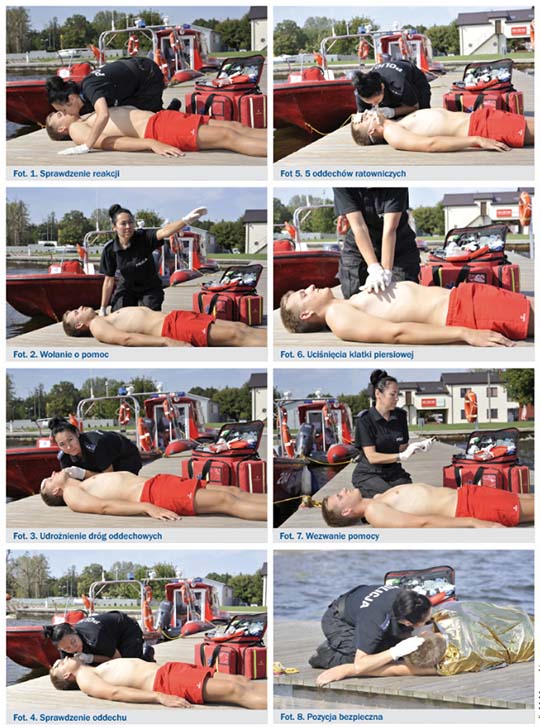 Saving the drowning in water and drowned on land.