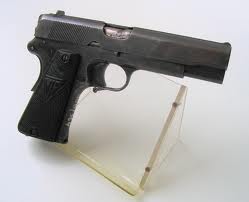
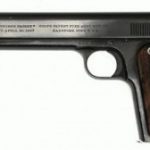
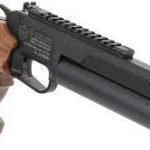
Constructed by two Polish engineers, Jan Skrzypiński and Piotr Wilniewczyc, great inventors and constructors - a self -tribute pistol
VIS in its time was one of the best constructions of this type.
A few words about VIS constructors
Professor Wilniewczyc and Skrzypiński also developed a Mors machine gun, which, however, was produced only experimentally - in the quantity 50 copies. (Which in practice meant using it in armed operations by one battalion.)
Then the war broke out, which interrupted the cooperation of the designers, Skrzypiński engineer, The then director of the State Rifle Factory in Warsaw refused the German side to cooperate in the field of weapon production, died 7 December 1939 year.
Piotr Wilniewczyc was in the country, He was a soldier of the Home Army.
In the conspiracy he was still involved in the structure of the weapon, developed mines. STEN machine gun. After the war he was a university lecturer, He was still in the construction of weapons, Together with Stanisław Rojek, he designed the WIR WIR pistol. 57, which has never been produced as standard. His last work was the machine gun Rak WZ. 1963.
The first name of the pistol is "WIS", She came from the names of the designers, However, at the request of the Department of Armament of the Republic of Poland, it was changed to vis, with Latin. force.
Secret of the structure
The VIS pistol began to be produced seriously around the same time as the iconic FN Browning HP, A few years after the TT gun, and ok. 24 Years after the original - Colt M1911; For me, it is such a characteristic structure, that I easily distinguish him from the others, and also the original from which borrowings are not lacking.
Interestingly, So characteristic of Colt was borrowed to this Polish construction, none of the other listed constructions inspired by 1911 He did not maintain this "tradition".
Another mechanism in favor of VIS is the chanterelle release lever on the left side of the lock, which is important and, what is important, a safe solution. Construction solutions - unlocking, locking and stopping the barrel, Just like its casting were innovative, which resulted in their patenting. Belgian browning hi power is certainly exceeding him with the capacity of the magazine (double -breasted 13 cartridge), ale ergonomia, balance, and the accuracy of vis-a is not inferior to him. Fact, that during the war, the Germans produced Visa as standard for their own use, it already gives a view on the quality of this construction.
One of the best pistols during World War II - I can say it boldly.
Technical data
Państwo Polska
Producent Fabryka Broni w Radomiu
Type: pistolet samopowtarzalny
Prototypes: 1930
Mass production 1935 – 1945
Before the war, in FB Radom was made approximately 50 thousands of copies.
The total amount of visits produced is ok. 350 000.
Caliber 9 mm
Cartridge: 9 x 19mm Parabellum
Magazine: uniform on 8 cartridges
Dimensions
Length 200 mm
Height 140 mm
Barrel 120 mm
Długość linii celowniczej 156 mm
Time
broni 950 g (no magazine)
1120 g (with loaded magazine)
Practical rate of fire 10 shot/min.
Effective range (actually typical even for modern constructions, as well as for ammunition) to 50 m.
Summary
It gets nice to the Pole when he sees, that something native, which shoots and is good, we managed to produce.
Before the war, we had engineers by large "and", Pity, that after the war the system pressed us TT, which did not grow up to our visa.. It's like deliberately undoing the reinforcing technique back to the period before producing VIS. Successfully WZ. 35 It would serve us as long as our western (present) allies from overseas Colt 1911.
After the war, the pistol was produced in small parts for collectors. Pity, that FB Łucznik in Radom did not maintain its production - certainly clients would not lack, And it would certainly be a more sought after product than their current range.
Visa I would buy even me - a supporter of German and "browning" construction. There are still a lot of copies in good condition abroad, some produced during the war by the occupier, Of course, without our eagle.