EXIT
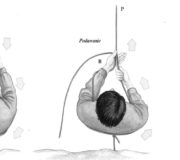
It's a quick and fairly simple way to beat the wall down. The rope should be fixed well by put it through the edge of the wall, that it hangs freely. On the rope you go down in the so -called downhill key. The rope must pass under the right thigh, at the slant through the breast above the left shoulder and back of the back. With the left hand, the end of the rope passing between the legs, and the right – hanging. Right hand is a blocking hand. Approaching it, the angle of wrap increases, and reduces the speed of the exit, distant – the other way round. Left hand – The lecturer helps maintain the right body position, it must not be cluttered with the ropes. At the congress, the body position must be straight as possible; Legs slightly spaced should touch the rocks. It is good to try to "go" on the wall with small steps.
Exit – Right hand controls the speed of the exit.
 Climbing extract
If it is necessary to overcome the wall higher than the length of the rope, You have to climb in stages – from one belay stand to another. Etapy TE, not exceeding the length of the rope, are called lifts.
1 The leader climbs the easiest and safest path. Heems or other belay cubes in crevices can be put in difficult places and connect them with a rope with a rifle, creating a through a passing point. In case of falling off, such points shorten the length of the flight. Standing in the lower position, he protects the leader, giving him a rope.
2 After reaching the appropriate place to set up a position, the leader assumes self -relief, which begins climbing by eliminating the belaying points on the way assigned by the lecturer. Standing in the upper position, He protects the approaching by choosing a clearance as needed. When both climbers stand in the upper position, You can start a new lift.